Article: Chablis or Petit Chablis? The secrets of two great terroirs from the Chablisien region.
Chablis or Petit Chablis? The secrets of two great terroirs from the Chablisien region.
Welcome to the Clotilde Davenne Estate journal. Make yourself comfortable, perhaps with a glass of Chardonnay in hand, as we gaze from our windows in Préhy at the rolling hills that have made our vineyard world-famous. If there's one question that regularly comes up in discussions in our cellar, it's this: "What's the difference between a Chablis and a Petit Chablis?"
Behind the adjective "Petit" (Small), some mistakenly imagine a second-rate wine or a sub-appellation. What a mistake! In the Chablis region, nothing is small: it's all about nuance, relief, exposure, and geology. Let's travel together into the heart of our terroirs to decipher what distinguishes these two sister appellations, and discover how we express their personalities here at the estate.
A Story of Circles and Geography: Locating the Appellations
To fully understand the Chablisien mosaic, one must visualize concentric circles drawn around the Serein, the peaceful river that flows through and shapes our valley. Recognized by Appellation d'Origine Contrôlée (AOC) decrees—in 1938 for Chablis and in 1944 for Petit Chablis—these two entities share the same overall production area, spread over about twenty communes. Yet, their borders delineate very distinct landscapes.
The Chablis village appellation forms the beating and historical heart of the vineyard. It currently spans approximately 3,710 hectares according to official data from the Bureau Interprofessionnel des Vins de Bourgogne (BIVB), mainly occupying well-exposed hillsides and secondary valleys.
Petit Chablis, on the other hand, crowns the peaks of our vineyard. With its approximately 1,286 hectares in production, it is primarily established on high slopes or at the beginning of plateaus, at slightly higher altitudes, generally ranging between 230 and 280 meters. It is therefore not a question of value, but of positioning within our landscape: where Chablis flourishes on sheltered slopes, Petit Chablis gains altitude and embraces the more windy and cool plateaus.
The Duel of Geological Eras: Kimmeridgian vs. Portlandian (and the Préhy Exception)
If you ask a local winemaker, their answer will inevitably turn to the subsoil. Geology is the cornerstone of Chablis' typicality. Theoretically, textbooks clearly separate the two appellations by their geological age.
Chablis village takes root in the famous Kimmeridgian soil. Formed about 150 million years ago during the Jurassic era, this unique terroir is a mille-feuille of marl and compact limestone, extraordinarily rich in marine fossils, notably the small oyster Exogyra virgula. It is this past as a warm ancient sea that imbues Chablis with its famous iodine notes, its direct profile, and its much sought-after mineral tension.
Conversely, Petit Chablis is traditionally associated with the Portlandian, a slightly more recent geological layer. Located on plateaus, this soil is composed of brown limestones, harder and less rich in fossils, giving wine profiles that are often more airy, immediate, and focused on fresh fruit.
However, nature loves to defy established rules, and that's where our story in Préhy becomes fascinating. At Domaine Clotilde Davenne, our Petit Chablis is an exception. Our Petit Chablis plots, planted in 1994 in Préhy and the Chantemerle sector, actually rest on deeply Kimmeridgian soil! Thanks to the vagaries of the geological faults in our area, the ancient rock and its oyster fossils directly outcrop on our west-facing plateaus. It is the Kimmeridgian speaking here, imbuing our Petit Chablis with a singular depth and salinity for its rank.
In the vineyard and cellar: production requirements
From a technical standpoint, the INAO specifications rigorously ensure the excellence of each appellation. Remarkably, for both Chablis and Petit Chablis, the maximum authorized basic yield is identical, set at 60 hectoliters per hectare. It is in the natural sugar content of the berries at harvest time that the requirements subtly differ: the minimum natural alcoholic strength by volume must be 9.5% for Petit Chablis, compared to 10% for Chablis village.
At the estate, our philosophy remains the same, regardless of the appellation level. Clotilde Davenne has always applied a fundamental principle:
“Nothing between the terroir and the glass. No wood, no makeup—just the dialogue between Chardonnay and chalk.”
Our Chablis and Petit Chablis are carefully harvested and undergo full vinification in stainless steel tanks. Alcoholic and malolactic fermentations start spontaneously at low temperatures. This 8 to 12-month aging in tanks preserves the absolute purity of the fruit and allows the raw, crystalline, and wild truth of our terroirs to express itself without the addition of woody aromas.
Aromatic Profiles and Culinary Pleasures: Two Distinct Personalities
During tasting, the distinction between the two wines becomes clear, offering two complementary faces of Chardonnay.
Petit Chablis is characterized by a lively, energetic, and immediate attack. Its color is a brilliant white gold with greenish reflections. On the nose, it exudes crisp aromas of citrus (lime, grapefruit), green apple, and white flowers like hawthorn. On the palate, it is a wine of great freshness, light and spontaneous, finishing with a saline and mouth-watering note.
Chablis village, on the other hand, shows more density, patience, and complexity. Its color is golden, clear, and crystalline. The nose opens with notes of stone fruits like white peach, mingled with nuances of almond and that chalky, almost smoky character reminiscent of flint or oyster shell. On the palate, after a frank attack, it unfolds a remarkable balance between a richer, more textured body and a vibrant acidity that stretches the wine into a persistent finish.
This duality offers magnificent prospects for food and wine pairings:
-
Petit Chablis is the undisputed king of aperitifs. Its vivacity awakens the taste buds alongside traditional gougères, fine cured meats, fish tartares, or fresh local goat cheese.
-
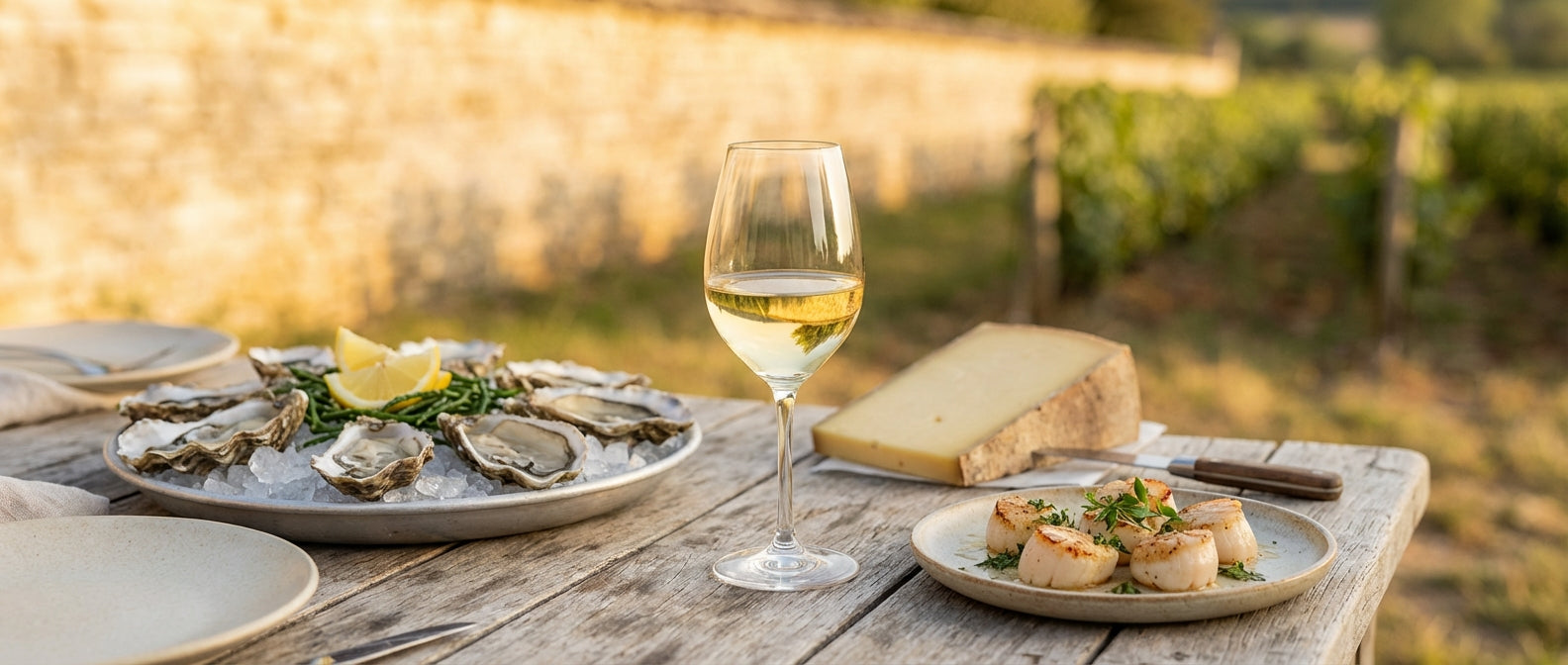
Chablis asserts itself as a great gourmet table wine. It will majestically accompany oysters from the open sea, grilled or poached fish, sushi, but also richer dishes such as fine Bresse poultry or frog's legs.
Serving Advice and Aging Potential
Knowing how to wait for a wine is part of the art of tasting. A classic Petit Chablis is generally designed to be enjoyed in its prime youth, within two to three years of its harvest. However, thanks to the unique Kimmeridgian terroir of our Préhy plots, our Petit Chablis possesses a structure that allows it to age serenely for 5 to 8 years.
Our Chablis village, from old vines planted in 1983 on the terroirs of Courgis and Vaudelune, has an aging potential of 10 years and more. Over time, its initial minerality will evolve into noble notes of undergrowth, honey, and dried fruits.
For serving, we recommend serving both bottles at a temperature between 10°C and 12°C. Avoid serving them too chilled, which would mask the delicacy of their aromas, or too warm, which would weaken the natural tension of the Chardonnay.
Conclusion: An Invitation to a Sensory Journey in Préhy
Far from being an opposition, the comparison between Chablis and Petit Chablis highlights the infinite richness of our Burgundy vineyard. Petit Chablis embodies immediate pleasure, joyful freshness, and spontaneous sharing. Chablis village offers a deeper immersion, ideal for extended discussions around a fine meal.
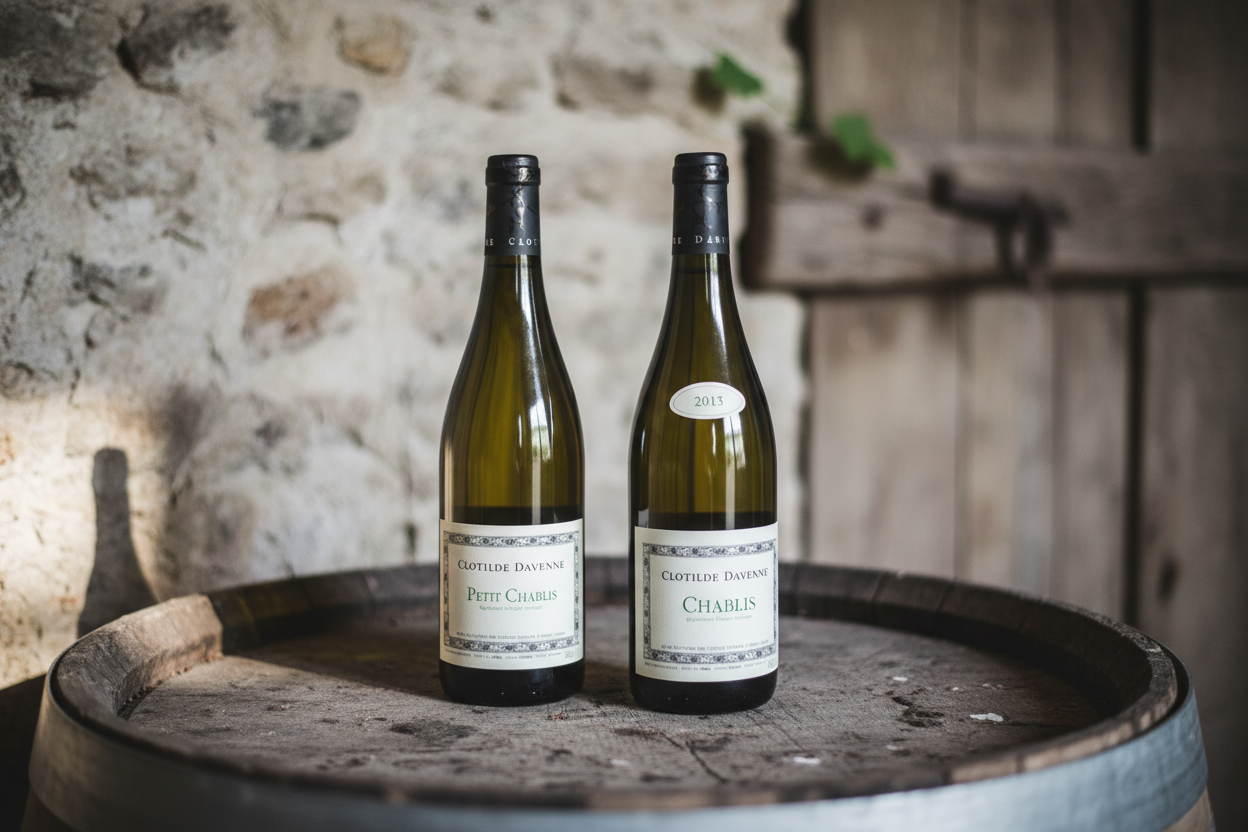
At Domaine Clotilde Davenne, we put all our expertise into ensuring that each bottle is the most faithful mirror possible of its plot. Whether you are looking for the refreshing vivacity of our Petit Chablis or the smoky complexity of our Chablis, you will find the same high standards and love of the terroir. We warmly invite you to visit our estate in Préhy to experience it in the cellar, or to discover our different cuvées in our online shop to bring a piece of our cherished terroir directly to your home.